Does the Child Support Office Know When You Have Switched Jobs
- Annotate
- Add to Favorites
There are many reasons people quit their jobs.
It'southward non always because of salary, like many people, including managers, accept been led to — sometimes erroneously — to believe.
The other reasons people quit could be different: they are getting married and moving; they have an unlikable boss; their goals are irresolute and they're leaving due to inadequate motivation or vision; they're leaving to acquire an advanced degree.
All of these reasons differ for every individual, and considering of that, they can be quite difficult for a manager to address.
That beingness said, employee retention is squarely in the domain of managers, and the majority of employees quit their jobs for reasons that are under the control of managers.
That is a fact.
When it comes to retention, managers make a difference
In every workplace, managers accept the power to control elements such as culture and environment, clarity of vision, employees' perceptions of their roles and responsibilities and providing tools to increase employee success. Because of this, managers tin exist one of the big reasons employees decide to leave.
If managers are doing their jobs and are in affect with their staff through regular communication, trouble-solving feedback, and recognition, they Tin can reduce turnover rates.
As a manager, yous have the ability to prevent issues with employee retentiveness by creating processes, systems and requirements that volition make employees stay longer and work productively in your company. Information technology is critical for managers to put these systems in place and support the needs of employees, increment market place compensation and benefits, generate meaningful work and accept a meaningful and meaning result on employees' work and workplace.
Someone once said, " People leave managers, not companies ," but is that truthful? Is this really the main reason why people get out?

Around June 2005, I had been working as a recruiter for virtually a year, and I found an article titled The Main Reasons Why People Leave Their Jobs. It focused on i topic: That managers are the primary reason why people leave jobs, and the 2nd reason is for a higher salary.
I have always been interested in this topic. As a recruiter, information technology's crucial to know the reasons why employees leave for another opportunity. It's also important to know why whatever 1 person is leaving the company because, in many cases, if i person is not happy then other team members could be unhappy for the very aforementioned reason.
That commodity made me question whether those two things were the real reasons why people leave their jobs. At that time, I was still new in recruitment, just during my first year, I had already heard many reasons why people wanted to quit.
Some of them were only looking for more money, and others shared scary stories almost their bosses, just many cited other reasons. I could not compare my findings with those in the commodity considering I did not have the data and I just don't like to estimate.
At that moment, I decided to first my own research. I was not certain if information technology was a proficient idea or not, but as always, the only style to detect out was to starting time. So. I started collecting information.
How Curiosity Turned into a Long-Term Hobby
I have ever said that the hardest office is when yous first doing something. One time y'all get past that, the rest is easy.
However, if you want to collect data and generate some adept results from it, starting is not enough — you also need a program. I thought I would never say this, just my sociology studies came in handy hither. In 2005, I started collecting the reasons why people left their jobs.
During every single exit interview (over the phone and in person) I always asked, "What is the main reason you lot are leaving your electric current job?" If the respond was "Considering of the boss," I added a point to the data set representing this reason in my Excel spreadsheet. If the answer was different, I simply added a new row to the spreadsheet and started a new count.
In that first twelvemonth lonely, I interviewed 679 people from various fields (Information technology, engineering, finance, marketing, sales, and more than), and my spreadsheet was total of reasons as to why people left their jobs. After the first twelvemonth, I asked myself whether data from one year was enough to cover every possible reason.
I knew that the examination grouping was not big enough because I had only a small number of people whom I had interviewed. I was also curious as to whether the reasons would change over the years. That is why I connected to collect data, unsure of how long I would have to keep.
This marvel turned into a hobby, and I continued collecting data for the next 10 years. The puddle of people grew from 679 to eight,509 (although I did not collect reasons from all the people that I interviewed). The pool of answers came from people with various levels of seniority and dissimilar fields, cities, and locations.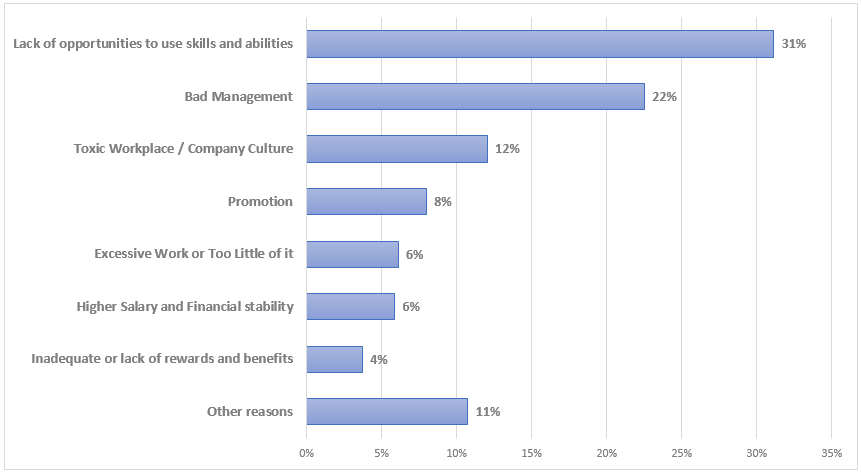
The Summit 7 Reasons Why People Modify Jobs
These are the seven (vii) main reasons why employees quit their jobs, based on my x-year research:
1 – Lack of Opportunity
When people can put their skills and abilities to use in the jobs they're doing, they tend to feel a sense of usefulness, self-conviction, and accomplishment. Employees are happier if they're engaged in activities at which they are good that exercise their skills and abilities fifty-fifty more.
People want to develop their skills, and if a job doesn't give them the power to do that, they volition start looking for one that offers information technology. This same applies to opportunities; if a workplace does non offer opportunities for growth and advancement, employees will get where they can find them.
People want to apply their noesis and improve at what they're doing. They're looking for a claiming, and if they experience that their skills are non being challenged, they will feel unfulfilled. Information technology'southward like a pilot who loves flying but isn't able to wing.
Remember: People are looking for fulfillment, purpose, and growth in their job.
2 – Bad Direction
In the article from 2005, managers were cited as the main factor causing employees to go out. During my research, I establish that managers remain amidst the top three reasons why people quit their jobs.
Considering a managerial position is usually a pace up on the visitor's ladder, and any worker can be promoted irrespective of their skill level, many organizations brand the error of promoting the wrong people into managerial positions. This is s a mistake because a director is a leadership part and requires skills such as interpersonal communications as well as the technical skills that are required for the job.
However, non all managers have these skills or take had the correct training to acquire them. Many organizations accept managers that exercise not give feedback or coaching, but instead, resort to screaming and yelling at the employees they're supposed to guide. In addition, unclear expectations can get out employees frustrated and make them desire to leave an organization.
If company leadership is non helping managers to develop into leaders, they will get-go losing employees, and in the terminate, they'll lose the managers themselves. The touch of this on hiring activities volition remain for a lot longer, though, because people who take already left due to a bad managing director volition non be sharing any positive reviews about that company.
Note: Bad management very ofttimes means that people had a bad dominate or bad local management team. For case, people who work in France for a company with headquarters in the Uk very often blame the local managers in their country for being bad, merely it could also be bad management in HQ in the UK and a great management squad in France. People can have a corking boss, only other colleagues (very often from other teams) may non and could create a toxic work environs. I know that there is a thin line between bad management and a toxic workplace, simply I decided to non to combine them together in my data just to share information technology in the way I nerveless it.
three – A Toxic Workplace or Company Culture
In an ideal workplace, everyone behaves with courtesy and colleagues complement i another. Bosses even bank check upwards on staff occasionally and are interested in what's going on in their personal lives.
However, every bit we all know, there is no ideal workplace, and personalities practice non ever blend so seamlessly. In every organization, some occasional clashes, interpersonal conflicts, office gossip, cunning workers, sly bosses, attention-seeking colleagues, and inconsiderate co-workers could appear, and any of those could turn into the reason that workers consider leaving a job.
I of the problems could be inter-office contest. Fifty-fifty if a workplace is generous, providing flexible hours and generous holiday, a workplace filled with competitors might really hinder workers from making full use of the benefits available to them. Employees may feel that making use of them past, for example, scheduling vacations, could get them penalized, causing them to be at a competitive disadvantage and making them feel dissatisfied.
Visitor civilisation tin vary from department to department and fifty-fifty from director to manager, so leaders in every company need to be consistent in building the same civilization throughout the entire arrangement.
4 – Career Advancement and Promotions
When most people they realize that they are not moving up the ladder, they leave. If they find out that, despite how difficult they have worked or how well they are doing at their job, they will non exist promoted to a higher paying and more than demanding position, they will go out.
In the same vein, if a less qualified or less capable member of the squad gets a juicy position that the more qualified employee wants, he or she may start to look elsewhere.
Sometimes, the company does not have space for six managers in ane modest team of x people, just people still desire to motility upwardly the ladder.
five – Excessive or Besides Little Work
Adept employees are often asked to take on many tasks, primarily because they may have, at one fourth dimension or another, used their initiative to exercise more than piece of work than they were initially asked to do. Actress tasks can cause a good employee to piece of work long hours, causing frustration and lack of motivation, which could ultimately lead to full exhaustion. In the same vein, a very good worker might encounter roadblocks when they are asked to take on new tasks, which can result in boredom and a lack of fulfillment.
More work or bigger projects come very often with more responsibilities. Adding more tasks and not giving employees the right level of guidance or ownership but leads to frustration. Nobody likes micromanagers.
6 – A Amend Salary and Fiscal Stability
During his most notable monologues, the vivid British philosopher Alan Watts ofttimes asked, "What if coin was no object?" Watts would try to encourage people to ignore the trappings of money and instead follow their hearts and passions equally if money was, indeed, no object. If they truly committed to that pursuit, he suggested, so the money would come up.
Nonetheless, allow's face it: money matters. It pays the bills. Later all, everyone has to call up well-nigh their personal finances when he or she decides which organization he or she wants to work for.
Because of all of that, coin is also a reason why employees exit their jobs. If a new job offers just a small raise, people do not care; if you offer them a significantly college wage, yous will get their attention.
7 – A Lack of Rewards and Benefits
No employee wants to work eight hours a day on full throttle without being recognized or well compensated. When an organization has no bonuses or benefits, and employees go unrecognized, it significantly reduced loyalty.
Bonuses that were promised merely non delivered would definitely not encourage employees to brand whatsoever actress attempt or work more hours if needed. For whatever company to encourage workers to stay, it should recognize and encourage its employees financially and publicly or else they will be forced to look elsewhere.
It's of import to celebrate their wins and be there for employees if they need your back up. People who experience appreciated and are noticed and recognized become more productive.
 A Bonus Reason Why People Quit
I'm sure that you have probably never heard this reason, but it is my favorite one.
Many years ago, I got this from someone: "My boss told me that I can't bring my turtle to work anymore, and so I'm looking for a new task." I'thousand still non sure if that lady was joking or not, but she sounded pretty serious nearly it.
Mayhap just having a pet-friendly workplace would accept helped her employer go along her.
What could be the game changer?
More people will be interested in companies that offer private medical services so that employees do not accept to wait days to see a doc. Also, companies offering advanced programs of professional training or fifty-fifty private career coaching could gain an advantage over their competitors in the market.
Notwithstanding, think this: A nifty visitor culture will always trounce any proficient benefits.
What I Learned Most Why People Quit
So, what did I learn from this survey?
Some of the reasons that employees quit their jobs have changed over the years. Most of the people in 2008–2011 preferred job security over cool benefits, an amazing part, or the environment. In the years earlier 2008, a higher bacon was the main motivation.
After 2011, the main reasons employees left started shifting toward things like benefits and the environment. From 2014 and on, more people started leaving their jobs for better opportunities that provided career advancement, a more than supportive culture, and one where managers gave them more responsibility than their current managers did to decide things for themselves.
If employees exercise non trust management to atomic number 82 them in the right management, they lose respect for them and will eventually leave. If you want happy employees, I strongly urge you to recognize their work, pay them adequately, and invest in them. They could still get out for any number of reasons, simply if you are not investing in them, they will most certainly go out for certain.
Yes, the reasons for leaving a task tin vary wildly, but sometimes the reason is very uncomplicated.
Sometimes, another offer somewhere else is and then tempting that people are not able to say no to information technology. That's not because of the money, merely rather, because they believe that the next opportunity is THE big claiming in their career.
- Comment
- Add together to Favorites
Authors

Jan Tegze
Jan Tegze is Senior Recruiting Manager at SolarWinds, a company that "provides powerful and affordable IT management software to customers worldwide, from Fortune 500 enterprises to modest businesses, managed service providers (MSPs), government agencies, and educational institutions." He is as well the author of the volume Total Stack Recruiter: The Mod Recruiter's Guide , published October 2017. Jan has extensive experience in full life bike recruiting, and wide knowledge in international recruiting, sourcing, recruitment branding, marketing and pro-agile innovative sourcing techniques. Connect with him on LinkedIn or follow him on Twitter@jantegze .
Recruit Smarter
Weekly news and manufacture insights delivered direct to your inbox.
Does the Child Support Office Know When You Have Switched Jobs
Source: https://recruitingdaily.com/7-big-reasons-people-change-jobs/
0 Response to "Does the Child Support Office Know When You Have Switched Jobs"
Post a Comment